
Last updated: 3 March 2026
Most “fund formation” pain is not legal theory. It’s execution.
The structure looks fine on a diagram, but then:
– bank onboarding stalls,
– counterparties ask basic questions no one prepared for,
– approvals are unclear,
– records are scattered,
– and the fund becomes unmanageable as soon as it gets busy.
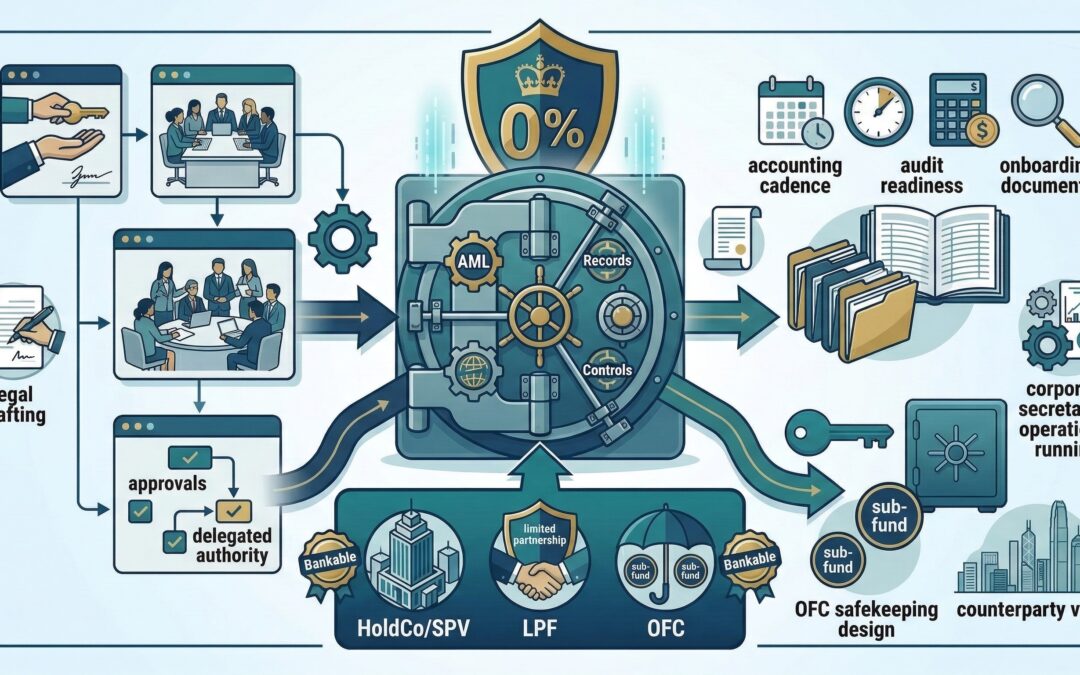
This is what we mean by a “bankable” structure: a fund or private investment vehicle that can be explained, evidenced, and operated cleanly year after year.
If you’re exploring a Hong Kong structure, start with our Investment Funds practice page:
—
The 3 pillars of bankability
Pillar 1: A control story that makes sense (who can do what)
Banks and counterparties want to know:
– who has authority to instruct movements of money,
– who approves investments and disposals,
– what internal approvals exist (and whether they’re documented),
– how conflicts are handled.
This is governance, not “legal decoration”.
If you’re structuring a holding stack, our Corporate & Commercial practice often supports this layer:
Pillar 2: Records that exist before you need them
When onboarding or a review happens, you don’t get time to build records retroactively.
In practice you need:
– an approvals log (what was approved, when, by whom),
– an investor onboarding pack (CDD, declarations, source-of-wealth/source-of-funds support),
– clean accounting cadence (monthly/quarterly),
– audit readiness.
If regulatory mapping is relevant, our Regulatory practice can help:
Pillar 3: Asset and cash safekeeping mechanics (especially for OFCs)
If you’re using an OFC, custody and safekeeping design is central to whether the structure works.
Start with:
—
The “Bankable Structure Checklist” (forwardable to clients)
1) Governance Pack
– structure chart (entities + roles)
– signatory matrix (bank + internal approvals)
– delegated authority rules (what management can do without board approval)
– conflicts policy
– template minutes / written resolutions
2) AML & onboarding narrative pack
– source-of-wealth/source-of-funds narrative that matches the structure
– supporting documents organised and consistent
– investor classification approach (where relevant)
3) Operational cadence
– monthly bookkeeping rhythm
– quarterly governance review
– annual audit timeline
– compliance calendar (filings, renewals, registers)
—
Why this is where TITUS × IMSG becomes a better partner model
Many firms can draft documents.
Fewer firms help clients keep the structure clean and credible over time.
TITUS supports legal formation and operating documentation for funds:
Our sister team – IMSG supports the operating layer that keeps structures “alive”:
– company secretarial and filings,
– accounting/tax coordination,
– internal controls and reporting rhythm,
– practical readiness for banking and counterparties.
—
Which vehicle is easiest to keep bankable?
It depends on facts, but broadly:
– HoldCo + SPVs: simplest operationally if governance is designed properly.
– LPF: bankable when roles/records/authority are tight.
– OFC: bankable when custodian + investment manager sequencing is done early.
If you’re choosing, start here:
Hong Kong Funds & Private Investment Vehicles guide
—
Next step: quick call with our Principal
If you want to discuss a client fact pattern or your firm’s recurring needs, we can set up a quick Zoom call with Michael Titus (Principal, TITUS): https://titus.com.hk/our-people/michael-titus/
Send 2–3 time slots to us via:
Email: info@titus.com.hk, or
Whatsapp: +852 9720 3003
—
Disclaimer: This article is for general information only and does not constitute legal advice. Specific advice should be sought for your particular circumstances.
RELATED READING
– Pillar guide: Hong Kong Funds & Private Investment Vehicles guide
– LPF guide: LPF (Limited Partnership Fund) guide
– OFC guide: OFC (Open-Ended Fund Company) guide
– DIPN 61 (plain English): DIPN 61 explained (Unified Fund Exemption)