
Last updated: 13 March 2026
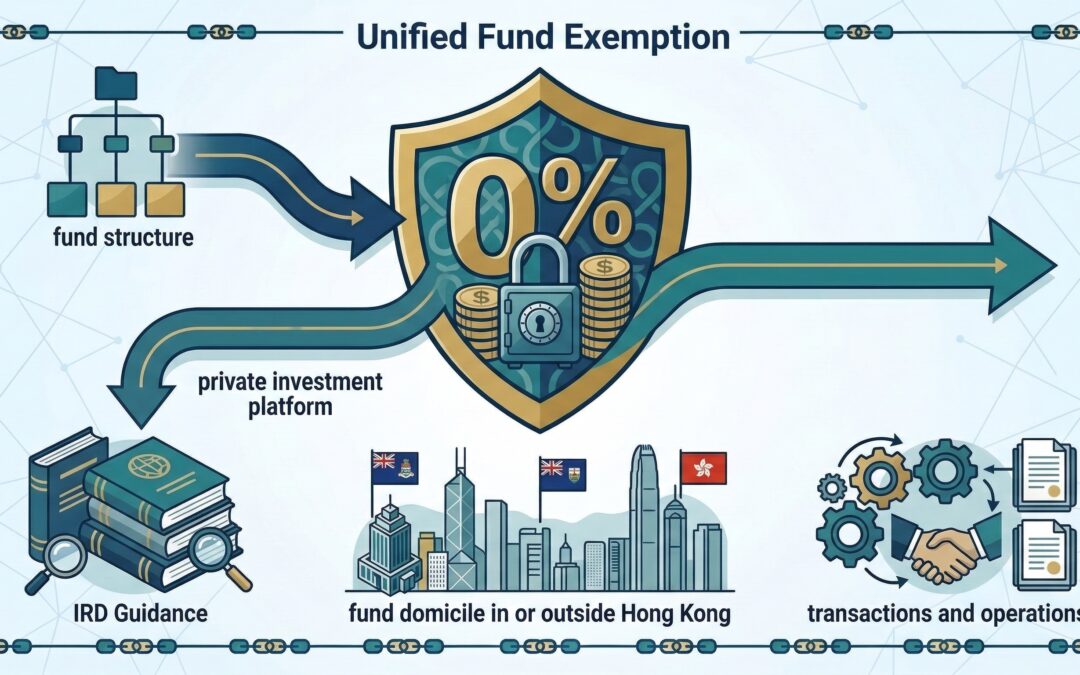
DIPN 61 is the Inland Revenue Department’s “Departmental Interpretation and Practice Note” explaining how it interprets and applies Hong Kong’s profits tax exemption for funds (often called the “unified fund exemption”).
If you are advising a fund manager or a private capital group operating in Hong Kong, this note matters—not because it guarantees an outcome, but because it signals how the IRD views key concepts and conditions.
If you want help applying this to a specific structure, start here:
—
What DIPN 61 is (and what it isn’t)
DIPN 61 is:
– IRD guidance on interpretation and application of the funds profits tax exemption regime.
DIPN 61 is not:
– a blanket promise that “funds pay zero tax”,
– a substitute for analysing facts, activities, and structure design.
—
Why people search “DIPN 61” in the first place
Typically, the question behind the search is:
“Can my fund (or private investment platform) operate in Hong Kong without creating unexpected profits tax exposure?”
In practice, the answer depends on:
– whether you meet the definition of “fund” for the relevant provisions,
– the nature of transactions,
– who carries out or arranges transactions,
– how the structure is operated in real life.
—
Three common misconceptions
Misconception 1: “If it’s a fund, it’s automatically exempt”
Not necessarily. The regime is condition-based and fact-driven.
Misconception 2: “Domicile solves everything”
DIPN 61 makes clear the regime is intended to cover privately offered funds operating in Hong Kong, whether domiciled inside or outside Hong Kong—subject to conditions. Domicile is not the only variable.
Misconception 3: “We’ll deal with tax after launch”
This is where problems start. If documents, operations and governance don’t match, you create unnecessary risk.
That’s also why we push “bankable structure” thinking early:
How to build a “bankable” Hong Kong fund (AML, records, controls)
—
Practical takeaway: how to use DIPN 61 in real structuring work
We typically use DIPN 61 as part of a larger “design pack”:
– define whether the structure is truly operating as a fund,
– map how transactions are sourced, executed and documented,
– ensure agreements reflect actual operations,
– design governance and record-keeping so you can evidence reality.
If you’re still choosing between LPF vs OFC vs a holding/SPV stack, read:
Hong Kong Funds & Private Investment Vehicles guide
—
Next step: quick call with our Principal
If you want to discuss a client fact pattern or your firm’s recurring needs, we can set up a quick Zoom call with Michael Titus (Principal, TITUS): https://titus.com.hk/our-people/michael-titus/
Send 2–3 time slots to us via:
Email: info@titus.com.hk, or
Whatsapp: +852 9702 3003
—
Disclaimer: This article is for general information only and does not constitute legal advice. Specific advice should be sought for your particular circumstances.
RELATED READING
– Investment Funds practice: Investment Funds practice page
– LPF guide: LPF (Limited Partnership Fund) guide
– OFC guide: OFC (Open-Ended Fund Company) guide